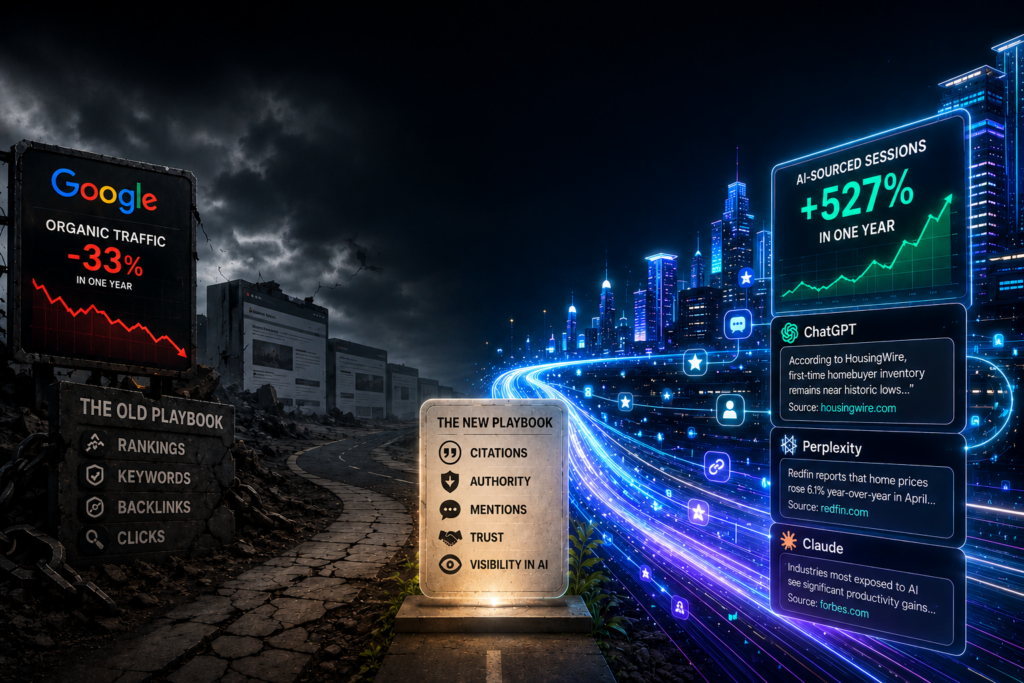
Google traffic to publishers dropped 33% in one year. AI-sourced sessions surged 527%. The audience has moved, and the playbook for reaching them is fundamentally different.
The shift in numbers
- 527% growth in AI referral sessions, H1 2025 vs. H1 2024
- 14.2% AI search conversion rate vs. 2.8% from Google organic
- 38% drop in US organic Google referrals, year-over-year
For a decade, publishers optimized for one thing: Google’s ranking algorithm. Get to page one, earn the click. That model is breaking down. Google now answers queries with its own AI Overviews, and when an AI Overview appears, only 8% of users click a traditional result, down from 15% without one. The traffic did not vanish. It moved to AI.
The rise of ChatGPT, Perplexity, Gemini, and Claude as primary research tools has created a new discovery layer where being cited in the answer is the new page-one ranking. AI referral traffic is still a fraction of total web traffic, but it is growing at triple-digit rates and converting at five times the rate of organic Google. The publishers who act now will build citation authority that compounds. Those who wait will find the moat already dug by their competitors.
Citation authority, like domain authority before it, compounds over time. The brands that invest in GEO in 2026 will be the brands AI systems cite in 2027, 2028, and beyond.
What is Generative Engine Optimization (GEO)?
GEO, or Generative Engine Optimization, is the practice of structuring content and technical infrastructure so that AI engines like ChatGPT, Perplexity, Gemini, and Claude cite and recommend your content in their answers. Unlike traditional SEO, which optimizes for a ranked list, GEO targets how large language models retrieve, evaluate, and reference sources in conversational responses.
GEO is not a replacement for SEO. It is an additional layer, and the same domain authority signals that drive Google rankings also predict AI citation frequency. High-traffic sites earn three times more AI citations than low-traffic ones. The strategies compound each other.
7 ways to optimize for AI citation
1. Open your doors to AI crawlers
The most common reason for zero AI citations is a blocked robots.txt. Explicitly allow GPTBot, OAI-SearchBot, ClaudeBot, PerplexityBot, and Google-Extended. If these bots cannot reach your content, nothing else matters. I am not saying take down your paywalls, keep them, look to meter them in a way that encourages spending more time on your sites.
2. Structure content for passage extraction
AI retrieves individual passages, not full pages. Keep paragraphs to 2 or 3 sentences. Open every section with a direct, standalone answer so AI can quote it without needing surrounding context. Lead with answers, not history.
3. Deploy schema markup
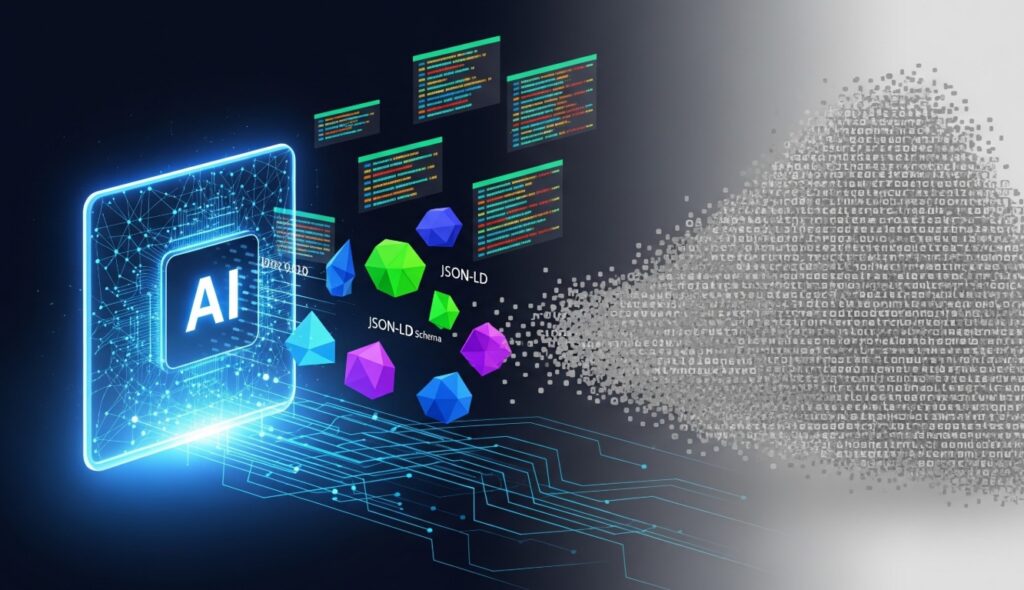
FAQ schema makes pages 3.2x more likely to appear in Google AI Overviews. Add FAQ, HowTo, and Article schema across key pages. For Copilot, prioritize table formatting. For Perplexity and ChatGPT, clear H2/H3 hierarchies are critical.
4. Anchor claims with original data
The Princeton GEO study found that adding statistics and source citations each improve AI visibility by 30 to 40%. Publish original research such as benchmarks, surveys, and annual reports that others cite. Original data creates a compounding citation network across your entire domain.
5. Publish fresh, dated content consistently
85% of AI Overview citations come from content published within the last two years, and recently updated content appears 4.3x more often in AI answers. Perplexity weights recency especially heavily. A new article on a trending topic can outperform an older comprehensive guide.
6. Build multi-source brand authority
ChatGPT pulls from training data and favors cross-source consensus. Getting mentioned on trade press, Wikipedia, forums, and industry references matters because AI models build authority through corroboration across independent sites. Expect a 3 to 6 month runway before consistent ChatGPT citations appear.
7. Measure it like a channel
Build a set of 30 to 60 stable test prompts using real reader and buyer language. Run them weekly in ChatGPT, Perplexity, and Google with AI features on. Track which URLs get cited, which paragraphs are pulled, and which competitor displaced you when you lose. Close the loop with content edits you can attribute.
Why acting now matters
GEO is still an emerging discipline with lower competition than traditional SEO. Most publishers have not started. AI models develop source preference bias. Once a source proves reliable on a topic, the model favors it for related queries. Citation moats built today will be difficult for competitors to overcome later.
The brands that are cited in AI answers in 2026 are the brands that published structured, authoritative, data-backed content today. The window is open. It will not be for long.
We are passionate about your success. We are here to help!