
Every publisher I talk to right now is asking some version of the same question: how do we get cited by ChatGPT, Perplexity, Google AI Overviews, and Gemini? The instinct is usually to start with content: write more FAQs, add more schema to articles, publish an llms.txt file. All of that has a role to play. But there’s a structural piece sitting in plain sight that most sites completely waste: navigation.
Answer engines don’t all work the same way, but they share one need
It’s tempting to talk about “AI search” as one thing. It isn’t. Google AI Overviews leans on Google’s existing index and Knowledge Graph. Perplexity and ChatGPT’s browsing mode fetch and read pages in real time. Gemini draws on its own mix of sources. Each system has a different pipeline, and none of them work exactly like a human clicking through a menu.
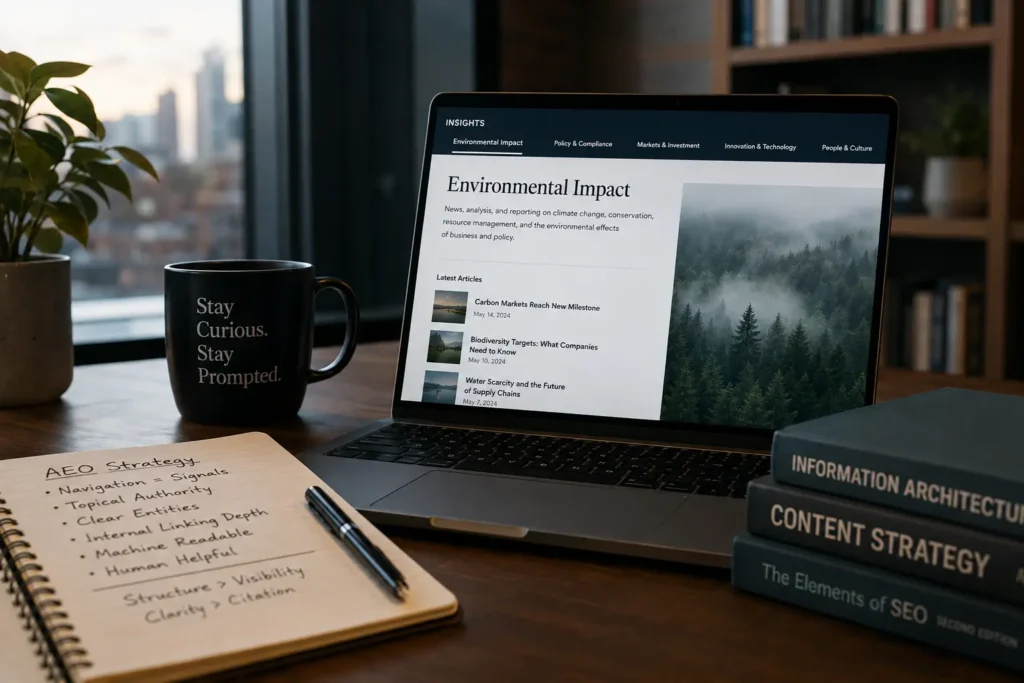
What they share is this: they’re trying to answer two questions as fast as possible, what is this publication actually an authority on, and which exact page best answers this specific sub-question. A nav label like “News” or “Insights” carries no information toward either question. There’s nothing to anchor an entity relationship to. Compare that to a nav structure organized around real coverage areas, each with a clear scope: Environmental Impact, Policy and Compliance, Markets and Investment, and so on. That’s a taxonomy, and it’s exactly the kind of signal these systems, in their different ways, are all trying to extract.
Here’s what surprises people: many publishers have already built this. It just lives in the wrong place. We recently worked with a client whose editorial team had defined eight precise coverage areas, each with a one-line scope definition, on their authors and editorial standards page. Thoughtfully written, real subject-matter boundaries. But it was invisible to every crawler on the internet because it was buried on a page nobody links to and no schema ever referenced.
Why this is an opportunity worth prioritizing
If a site already has a real taxonomy, whether that’s five categories or twenty, that structure can become the backbone of AI visibility in a few concrete ways:
Topical authority clustering. Each coverage area becomes a hub page that internally links to every article underneath it. This is the structure GEO audits look for when they’re trying to determine what a domain is an authority on.
Defined entities, not labels. Each hub page can carry its own “about” entity and description in schema, matching the language the editorial team already uses to define that beat. Instead of guessing, an answer engine gets a direct definition.
A real topic map for AI crawlers. The same taxonomy that powers hub pages can inform an llms.txt file, a still-emerging convention that not every crawler treats the same way yet. It’s worth doing because it costs little and helps where it’s read, not because it’s a guaranteed citation lever.
Better internal linking depth. This is bigger than an AI play. Deeper, cleaner internal linking around real topics helps traditional SEO too. It’s one investment with two returns.
The mechanism matters as much as the intent. It’s not enough for a taxonomy to exist in an internal doc or an about page. The structure has to be expressed in the site’s actual navigation and carried through as machine-readable schema, wired to defined entities, not only labeled with friendly names.
What navigation can’t do on its own
I want to be direct about something, because I think the industry oversells structured data as a quick fix. It isn’t one, and it isn’t the whole picture.
If a site’s taxonomy is vague, inconsistent, or duplicated across sections, machine-readable navigation will faithfully describe that mess to every AI crawler that visits. Schema will not invent clarity, it transmits whatever clarity, or confusion, already exists in the site’s information architecture. The publishers who benefit most from this work are the ones who’ve already done the harder, less glamorous job: defining what they actually cover and drawing clean lines between categories.
Navigation and schema are also only part of what these systems weigh. Backlinks, third-party mentions, and being referenced by other authoritative sites still carry real weight in whether a system trusts and surfaces a source at all. A publication can have flawless internal structure and still go uncited if nothing else on the internet is talking about it. Treat navigation as the foundation that makes good content legible, not as a substitute for the off-site authority and editorial depth that earn citation in the first place.
There’s a practical tension here too. A taxonomy built to please a crawler isn’t automatically one that serves a reader. Editorial categories reflect how a newsroom organizes its coverage, not necessarily how someone phrases a question. The goal isn’t to restructure a site around machine preferences, it’s to make sure the structure that already serves readers well is legible to machines too. When those two things pull in different directions, the reader wins.
This also isn’t something you screenshot in a pitch deck. Structured data has no visible UI. You prove it out in a technical audit, a schema validator, or a demo where someone actually inspects the page source. It’s a real capability, but it earns trust through evidence, not through a slide. And it isn’t a one-time project, because taxonomies change. Editorial teams rename categories, merge beats, and retire old sections. Structured data tied to navigation needs to be revisited every time the underlying taxonomy shifts, or it quietly goes stale, describing a version of the site that no longer exists. Treat it like living documentation, not code you ship once and forget.
Where this leaves publishers
If you’re building an AEO or GEO strategy in 2026, don’t start by asking what more content you need. Start by asking whether your navigation already reflects what you’re an authority on, and whether anything on the internet actually knows that. For a lot of sites, the taxonomy already exists. It’s just sitting on an about page instead of driving the site.
That’s the shift. AEO isn’t a new discipline bolted onto SEO, and it isn’t a substitute for the off-site authority and editorial rigor that have always mattered. Increasingly, though, the navigation problem and the AEO problem overlap more than people realize, and the publishers who see that first, without treating it as a silver bullet, are the ones who’ll get cited first.
Stay curious. Stay prompted.